COP30: From Moral Failure to a Paradigm Shift in Valuation and Governance.
The UN Secretary-General’s assessment of a “moral failure” to limit warming to 1.5 °C feels deeply resonant. For me, as an Environmental Architect and ESG Specialist, this critique goes beyond mere politics; I view it as an exposure of a profound architectural and economic failure. Our dominant economic models have consistently failed to value land, ecosystems, and natural timescales as anything other than short-term consumables. I believe we must instead view these as Land Capital—assets whose health is intrinsically linked to our economic and physical viability.
This need for revaluation is supported by the science: 2025 has been one of the hottest years on record, and the concentration of CO2 shows the most significant single-year increase in history. My professional focus is on shifting the dialogue from simple mitigation towards a fundamental revision of our governance frameworks. The efficacy of major climate summits, such confinements as the upcoming COP30 in Belém, must surely hinge on moving beyond our current paradigm towards one that makes ecological preservation economically essential, rather than a discretionary add-on.
The Crisis of Valuation and Utopian Ego
I believe that our prevailing technocratic model actively encourages the systematic destruction of biodiversity, creating an incentive structure where short-term profit systematically depletes our ecological reserves (Stockholm Resilience Centre, 2022). This systemic flaw is palpable within the design and construction sectors, where the prioritisation of accelerated capital turnover and, I would suggest, a degree of ‘Utopian Ego’, often eclipses the necessity of preserving existing natural intelligence.
One observes the rise of large-scale developments that may be aesthetically striking and technologically ambitious, yet are fundamentally ecologically damaging or long-term economically unsustainable. These designs seem to fail the most basic test of ecological humility: the recognition that natural systems—our Nature Capital—are the primary intelligence upon which all human construction must be based. Strategic leadership, in my view, requires a profound shift from this ego-driven, extractive model to one rooted in systemic responsibility.
The Planetary Metabolism Crisis: From Rift to Mine
This systemic imbalance is physically manifest in our linear economic model. The intense practices of industrial agriculture systematically deplete biologically active matter from rural soils, transporting this biomass into urban centres, thereby creating a dual dysfunction: environmental depletion and urban pollution.
This break in the nutrient and energy cycle is what Karl Marx famously termed the “metabolic rift”. Furthermore, the global pursuit of materials for modern development, including the low-carbon transition, often drives aggressive resource extraction in what has been described as the “planetary mine” (Hickel et al., 2022).
It is here that strategic design must intervene. We need to recognise biological discards not as mere waste, but as colossal resources, capable of being repurposed as essential organic fertilisers or biogenic fuels. The challenge is how to integrate modern ecological and agricultural techniques into urban planning to close this cycle.

Figure 1. The Broken Linear Metabolism. Current economic models rely on a one-way flow, systematically depleting rural Land Capital and generating pollution and unutilized biomass in urban environments.
The Vulnerability of Stewardship: When Microclimates Fail
The vulnerability of those advocating for genuine stewardship, particularly organic farms, is a profound ethical and economic concern. They face unequal competition with major agro-holdings, primarily because they are compelled to operate within entirely different timescales. Sustainable practices require relying on natural time—for instance, effective soil health restoration often takes around three years. This timeframe is fundamentally incompatible with the rapid capital turnover cycles favoured by major players.
To compound this, the systemic loss of natural woodland and the resulting disruption to ecosystem balance fundamentally alters the local microclimate. This manifests as increased heat stress, extreme heat, uncontrolled fires, and unpredictable rainfall. The result is a direct threat to viability: the failure of young saplings to survive due to drought and intense solar radiation, and a critical loss of productive land. This climate-driven instability actively punishes those striving for sustainable practice, pushing already fragile businesses towards economic unviability.
How can we expect local stewardship to succeed when the underlying climate instability, caused by the very system we critique, actively punishes those striving for sustainable practice?
Reframing the Mandate: Designing Governance for Resilience
Revising Corporate Models for Asset Valuation
A potential tipping point could be the revision of corporate models to objectively account for the long-term value of land assets. It is crucial to acknowledge the fundamental dependence of private capital on overall planetary capital. Sustainable long-term profit is impossible without a healthy operating environment.
Restoring Inclusive Stewardship and Valuing Contribution
Historically established, local, and traditional inclusive methods of land management, often based on years of family knowledge and labour, risk being overlooked and rendered non-competitive. Support is necessary to ensure these operations become economically profitable.
This might be achieved via mechanisms that value and reward their contribution to ecosystem preservation and restoration (e.g., enhancing biodiversity, improving soil health). Establishing close synergy between academic research centres, local practitioners, and major agro-holdings is a key element for unifying knowledge and scale.
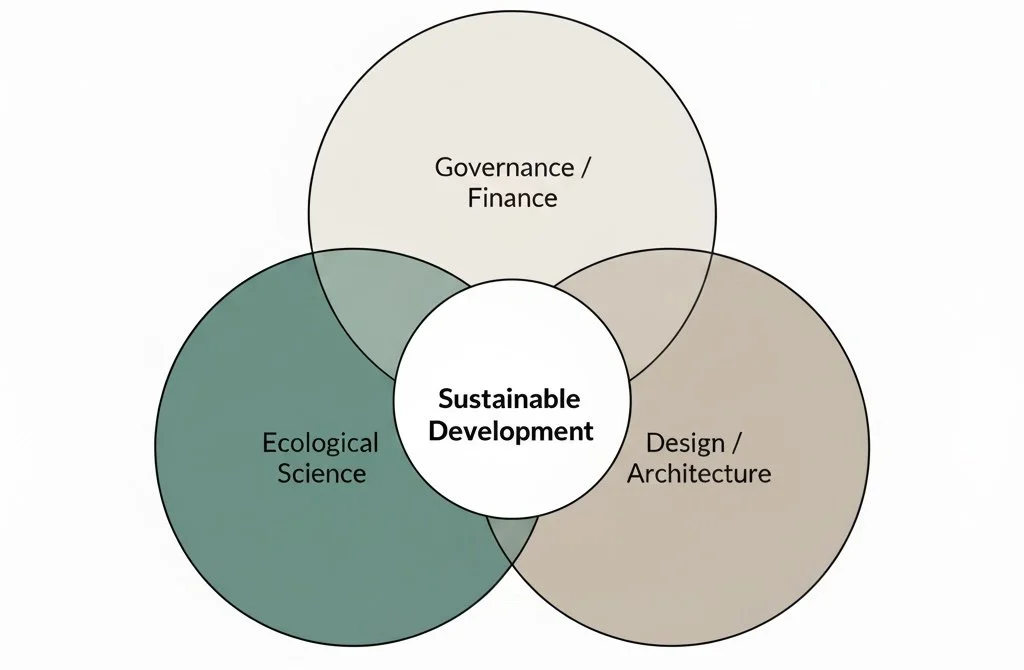
Figure 2. The Molecular Blueprint of Sustainable Development. Effective climate governance emerges from a precise, synthesised structure where strategic finance, ecological science, and visionary design are inextricably linked, forming a resilient foundation for the built environment.
Conclusion: The Mandate for a Responsible Future
The moral failure is, ultimately, a failure of governance and valuation architecture. Our human ecosystem demands a commitment to creating restorative, not extractive, environments.
My personal role, as a systemic thinker, is to build the dialogue between finance and the land. A viable future is only possible at the intersection of three key spheres: Ecological Science, Governance/Finance, and Design/Architecture. By unifying these disciplines, we can achieve sustainable development that protects, rather than penalises, those who take responsibility for the Earth.
The future of development is not just about being creative; it is about being ecologically responsible and strategically viable.
Ready to apply these insights? Discover proven, tailored strategies to embed climate governance and deliver sustainable outcomes.
© 2025 Liudmila Tuchkova / ESG Strategy. All Rights Reserved. This article contains original thought leadership. Quotation or reproduction of content is permitted only with clear, direct citation and a link back to this page (https://www.ltuchkova.com/insights/cop30-governance-shift).
References
Hickel, J., Dorninger, C., Wieland, H. and Suwandi, I. (2022) 'Imperialist appropriation in the world economy: Drain from the global South through unequal exchange, 1990–2015', Global Environmental Change, 73.
Poole, V. and Sullivan, K. (2021) 'Tectonic shifts: How ESG is changing business, moving markets, and driving regulation', Deloitte Insights, https://www2.deloitte.com/us/en/insights/topics/strategy/esg-disclosure-regulation.html[accessed 11 November 2025].
Stockholm Resilience Centre (2022) Planetary boundaries, https://www.stockholmresilience.org/research/planetary-boundaries.html [accessed 11 November 2025].
UN News (2025a) COP30 kicks off with urgent call to deliver on climate promises and scale up finance. 10 November 2025, https://news.un.org/en/story/2025/11/1166313 [accessed 11 November 2025].